Tolubai Synchy: Kyrgyz legend of the blind horseman and the spotted horse

Illustrations by Marie Laure Fromenteil, author and illustrator of Tchaar, cheval sacré des Monts Célestes.
The man who could read horses
According to popular legends, Tolubai lived between the 14th and 15th century, at the time of a very severe king.
Tolubai was a "synchy" thinker, he was an expert on selecting horses.
He was known for his ability to recognize the qualities of animals, especially of horses. He recognized at a glance which could become an excellent steed. These fast and enduring horses were very sought after and mythology represented them winged.
These exceptional animals were called "Toulpar".
People knew Tolubai syntchy as a clairvoyant, eloquent and wise personality; calling the people to friendship. But he did not obey anyone, not even the King!

The king's challenge
In those days, the country was ruled by a harsh king. Before setting out on a great campaign, he made an announcement: "Whoever finds me a tulpar among the horses of the kingdom will have anything he wants. If he fails, I will put out his eyes."
Every synchy in the land knew what the king was like, and not one of them came forward.

The old man by the rock
The king's servants rode from village to village looking for a synchy, and came back empty-handed each time. Then, on their way home one day, they found an old man sitting at the foot of a rock, crying over the dry skull of a horse.
"Who knew that you were a tulpar?" he was saying. "Who knows that I am a synchy?"
It was Tolubai. The servants took him to the king and told him what they'd heard.

"If you really are a synchy," said the king, "find me a tulpar among my horses. If you can't, I'll put out your eyes."

Three days at the tower
The next day, Tolubai and the king climbed a tall tower to watch. For three days the finest horses in the country were led past below them. Tolubai didn't like a single one.
Last of all came the king's own horses, draped in silk rugs. "Well, my synchy," said the king. "What do you say about these?"
Tolubai shook his head. "There's no tulpar here."
The king was furious. "Is there really no horse left?"
"Only one," said his servants. "A poor man's scruffy chaar."
"Bring it here. Now."

A horse with forty wounds
The best horsemen in the kingdom led it in. The chaar had forty wounds on its back and could barely walk. But the moment Tolubai saw it, he shouted, "My King, there's your tulpar!"
The king couldn't believe it. He thought the old man was mocking him. "Put out the eyes of this fool who laughs at me!"
The guards did as they were told. Tolubai covered his face with his hands and said, "My King, that was your order. But in return for my eyes, give me that poor chaar."
The king didn't even look at him. He waved a hand, and the horse was his.

Forty-one days
Tolubai took the chaar home and kept it in a dugout under the ground for forty-one days. He measured every meal and gave it water according to the weather. On the forty-first day, the horse was healed and full of strength.
Tolubai lifted his wife onto its back, climbed up behind her, and the two of them rode out.

The chase
It wasn't long before they met the king, who rode up and blocked their path.
"My King," said Tolubai, "if you're a real horseman, try to catch this poor chaar."
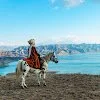
He let go of the reins and the chaar took off. The king couldn't stand the insult, and he set off after them with his whole court. But the spotted horse shot away like an arrow and left every one of the king's horses far behind. Tolubai had never ridden anything so fast or so tireless, and he carried on without a thought for the king's rage.

Three horses, three weaknesses
At the end of the first day, they heard hooves behind them.
"What horse is that?" Tolubai asked his wife, since he could no longer see.
"It looks like Tentek Kara."
"Then he won't last. He has a weak head. Ride towards the sun."
She turned them into the sunlight, and Tentek Kara flattened his ears, shut his eyes and pulled back into the shade.

Two days later, they heard hooves again. "Who's this one?"
"It looks like Uzun Kashka."
"He has weak hooves. Take us over the gravel."
Just as Tolubai said, after a few steps on the stones, Uzun Kashka couldn't go on.

On the third day came a sound Tolubai had never heard before, the hoofbeats of a truly exceptional horse. "Who's this?"
"It looks like Karager."
Karager was a real tulpar and famous across the kingdom. He was only seven years old and had no weakness anyone could see, except one. He couldn't bear to be praised.
"Let him come right up to us," said Tolubai. "I'll cover him in praise."
What his wife didn't tell him was that Karager was the king's own horse, and the king was riding him.
As she turned towards him, Tolubai called out: "Oh, you beautiful animal! How could anyone be born as fine as you? How magnificent you are, fast as light itself!"
Karager stopped dead and reared up, and no matter how hard the king urged him on, he wouldn't take another step.
Only then did Tolubai realise who was in the saddle. "My King," he said, "when I found you a tulpar without a single flaw, you couldn't see it. How could you ever judge a synchy, or a tulpar? The fault is yours, and grace belongs to the people."

Where Tolubai went
They say Tolubai rode his chaar all the way around the world, and then the two of them disappeared together into the sea.