for businesses, brands and funders
Put your name behind a horse that nearly disappeared
We are two full-time staff in the Kyrgyz mountains and a group of volunteers. With no grants, no sponsors and no marketing budget, we have taken a breed from one stallion and five mares to a herd of 80+ horses. Imagine what we could do with a partner.
What a very small team has built
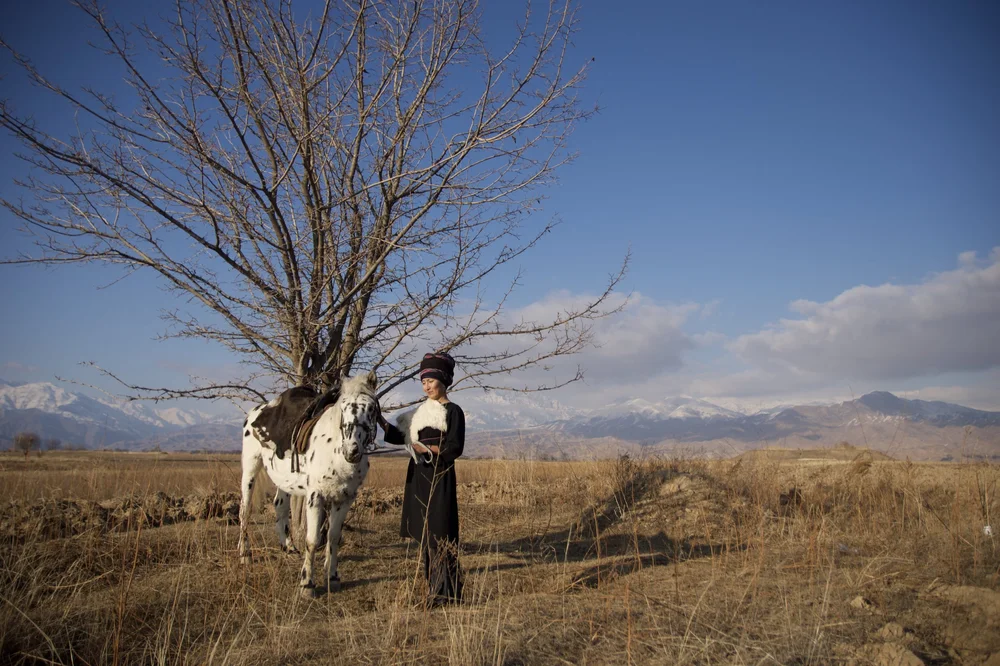
In 2012 Munarbek Kuldanbaev bought one spotted stallion, Chaar Suluu, and five mares. For the next eight years the herd barely grew. Wolves took three to six horses a year, and in hard winters there wasn't enough hay. By 2020 there were 15 horses.
Since then, with two full-time staff, Munarbek and the horseman Yrys, and everyone else a volunteer:
- 15 horses in 2020, 80+ today, 51 of them breeding mares.
- A ranch in the Ketmen-Tobo Valley, built in 2025, that cut winter feeding from six hours a day to one or two.
- A genetic study from Texas A&M University showing the Chaar is a genetically distinct indigenous population, with unusually high diversity.
- A documentary broadcast on BBC Four, and a silk scarf Alice Shirley designed for Hermès after seeing it.
- Supporters in ten countries, and a breeding programme that delivered its first foals to members in 2025.
- Two riding expeditions, in 2025 and 2026, and features in the UK, Sweden, Australia and the United States.
None of this was paid for by a grant or a sponsor. It came from members of our breeding programme, guests on our expeditions, and the auction of a painting by Alice Shirley: individuals paying for hay, one winter at a time.
That is the case for partnering with us. You would not be propping up a project. You would be speeding up one that already works. The next goal is 130 horses by 2029, on the way to 500, the pedigreed population we're working towards for breed recognition.
Raised the nomad way
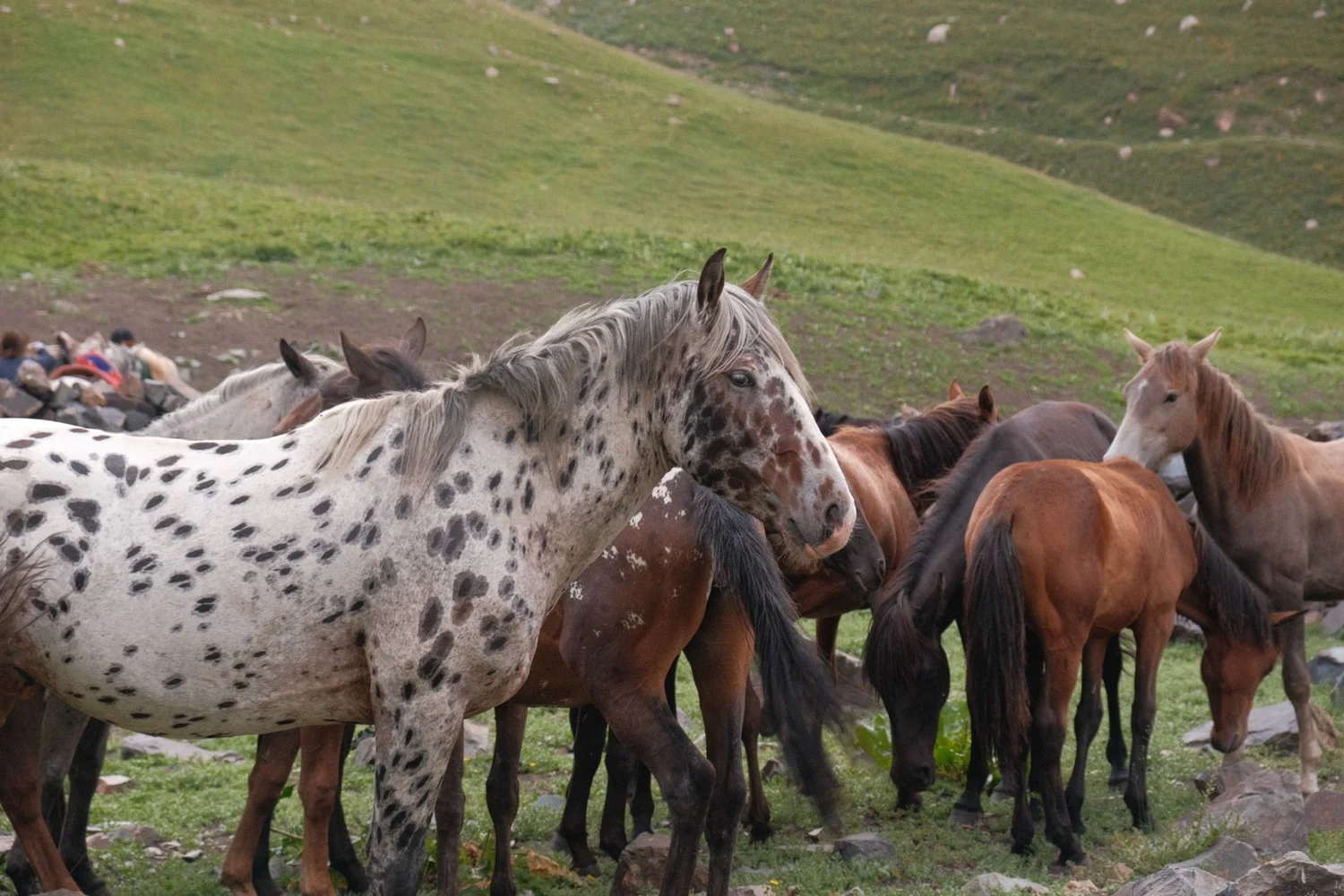
We raise the Chaar the way Kyrgyz herders always have. Each stallion lives with his own herd of mares, and the herd breeds naturally. There is no artificial insemination and no semen sent off around the world, as is common in modern breeding. A horse finds its herd and, ideally, stays with it for life, as Chaar Suluu has with his.
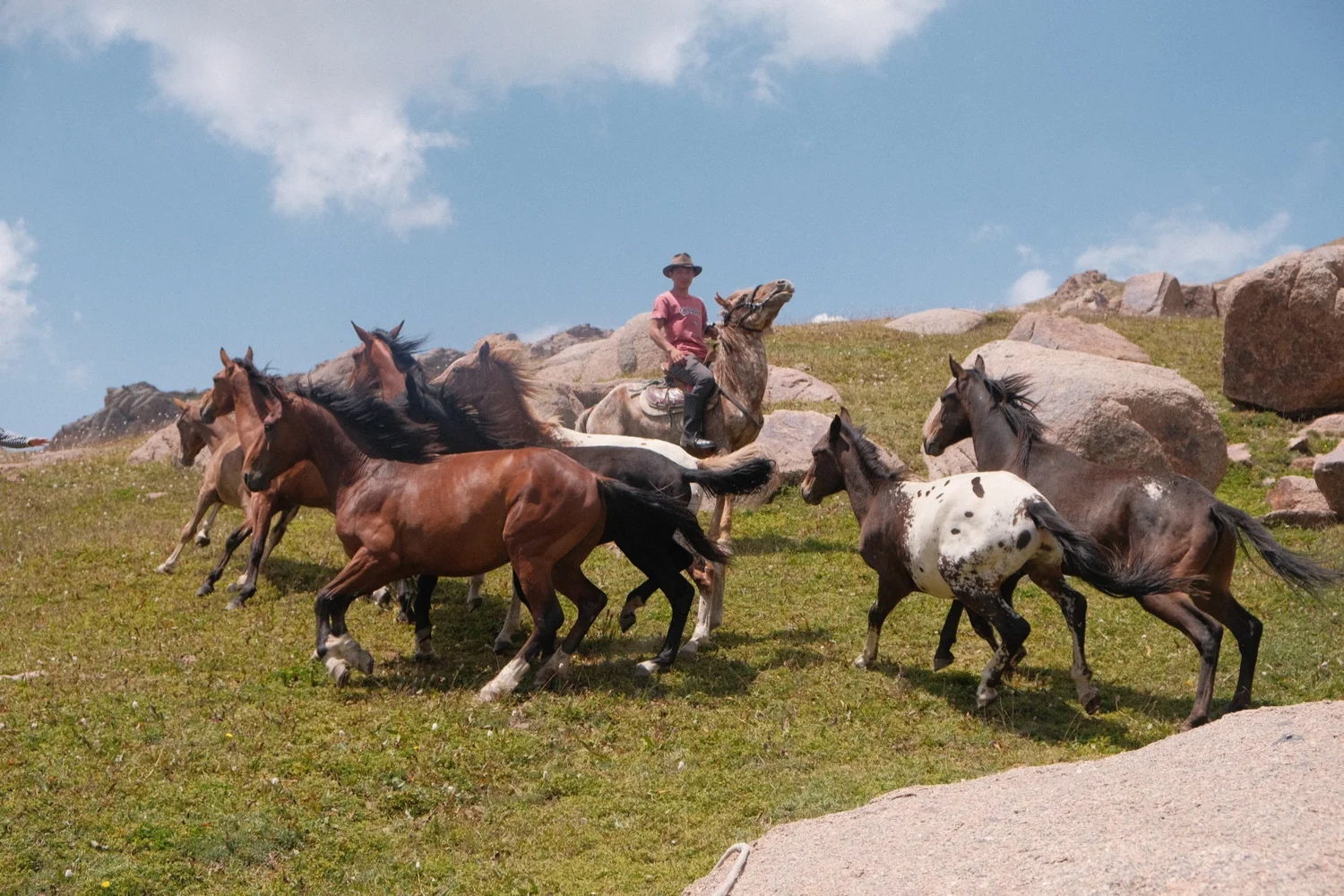
The herds live semi-wild in the mountains. We watch over them and bring them down to the ranch for extra food in the hardest part of winter, but on the pastures they find their own way. That is what keeps them intelligent, brave and sure-footed: the traits that make the Chaar what it is. Take a Chaar out of the mountains and into a stable or a paddock, and over the generations those traits slowly fade.
Doing it this way takes knowledge, skill, patience and a great deal of time. It is far harder than keeping horses safe in a stable, in a box, behind a fence. It is also the only way to keep the breed we are trying to save.
This association was built out of partnerships
Nothing here was started by one person with a plan. A Kyrgyz herdsman sold a spotted horse to a British film crew. A breeder in New Zealand saw that horse on television and wrote a letter. A laboratory in Texas ran the DNA. An illustrator in London drew the logo and gave it away. Herders across the valley knew where the last spotted horses were, and said so.
Every one of those was a partnership between people who had no particular reason to trust each other, and every one of them held. That's the association: a Kyrgyz operation on the ground, a French non-profit behind it, and a scattering of people around the world who each did one thing well.
So we know how to be a partner. We do what we say we'll do, we report back honestly, including when something hasn't worked, and we don't overstate what we've achieved. If you're working on biodiversity from another direction, whether that's land, species, food or the people who live alongside all three, we'd be glad to find out what we can do together.
Who we're hoping to hear from
We're not looking for a logo on a banner. We're looking for companies whose own work already points the same way, so that a partnership does lasting good rather than looking like good.
outdoor and adventure
Brands making clothing, equipment and gear for people who spend real time outside. Our herd summers on pastures up to 3,800 metres and winters at the ranch in the Ketmen-Tobo Valley, and the people working with them test kit harder than any campaign shoot. There's honest product testing here, and honest footage.
horse and equestrian
Feed, tack, veterinary, breeding, saddlery, riding holidays, anyone whose business rests on horses. Supporting a breed that came back from the edge is the most direct thing a horse company can do for horses, and your customers already understand why it matters.
ecological and regenerative
Companies working on biodiversity, land, climate and food, and those with a real environmental commitment rather than a page about one. A rare genetic line and the grazing that sustains it are a small, measurable piece of the planet to protect properly.
What these have in common is a long view. A herd is not a quarter, and a breed takes decades to bring back. If your company thinks in those terms, we'd like to build something with you that still matters in twenty years.
Why this stands up to scrutiny
the science is published
The Animal Genetics Laboratory at Texas A&M University compared hair samples from 30 Chaar horses, collected in November 2012, against 65 breeds, and reported in October 2022 that the Chaar is a genetically distinct indigenous population with diversity well above average for domestic horses. Read the report.
the story already travels
A documentary that premiered at Sun Valley and aired on BBC Four, a silk scarf Alice Shirley designed for Hermès after seeing the film, supporters in ten countries, and a steady stream of visitors who go home and tell people. Watch the film.
the money is visible
We're small enough that a sponsor can see exactly what their money bought. A registered French association that sends an annual financial report to every supporter, and a herd you can come and count yourself.
in the press
Novastan (2026)●Equestrian Life (2024)●Eurasianet (2023)●Radio Azattyk (2023)●BBC Four (2015)●More coverage
Three ways a company can work with us
Nothing here is a fixed package. These are the shapes partnerships have taken, and we're open to one nobody has thought of yet.
Sponsor something specific
Take on one real cost, for a season or a year, and we'll tell you exactly what it did.
- Winter feed for the herd, or a share of the season
- Veterinary care for a year
- A horseman's wages
- Shelter, fencing or transport
- The next piece of genetic research
Build something together
For brands whose customers would care about this horse, and who would rather make something than write a cheque.
- A co-branded product or limited drop
- Licensing artwork from our artists
- A campaign or film shot at the ranch
- Staff trips, retreats or volunteering
- A share of sales on a line
Fund the work
For foundations, trusts, grant-makers and institutions working on biodiversity, heritage or rural livelihoods.
- Breed conservation and the breeding programme
- Genetic research and official breed recognition
- Rural employment in the Ketmen-Tobo Valley
- Cultural heritage and nomadic tradition
- Multi-year core funding
A sense of scale
It costs about a euro a day to carry one Chaar horse through the winter, November to May. Everything else follows from that, and it means a modest corporate budget goes a very long way here.
€210
One horse, fed right through a Kyrgyz winter.
€1,050
Five horses through the winter, a mare and her foal among them.
~€17,000
Winter feed for the whole herd of 80-plus horses, the single largest cost of the year.
Let's talk
Wages, veterinary care, infrastructure and research are quoted properly, on the real numbers.
What a partner gets
- Credit wherever it makes sense: the site, the newsletter, social, and on the thing you funded.
- Photographs and film from the ranch that you're free to use, of a subject most brands can't get near.
- A written account of what your money paid for, with figures, at the end of the season.
- An open invitation to come and see the herd, and to bring people.
- For French companies, the same 66% tax reduction that applies to individual donors.
What we ask
- A commitment we can plan around, ideally across a season or a year rather than one moment.
- Honesty in how the partnership is described. We won't claim more than is true and we'd rather you didn't either.
- Room for the horses to come first when the weather or the herd says so.
- A conversation before a contract. We'd like to understand what you're actually trying to do.
What we can put in front of your board
- Registration as a French non-profit association, n° W353023160, with the legal obligations that carries. Founded in 2023; the work in Kyrgyzstan has run since 2012.
- An annual financial report, sent to members and supporters each year.
- The full Texas A&M genetic report, from a named laboratory, already public on this site.
- A documented herd with a known foundation line, photographed and written up season by season in the news.
- A named contact who will answer your questions directly, rather than a form.
How it works
you tell us what you're after
Who you are, what you'd want out of a partnership, and roughly what scale you're thinking. A short note is plenty to start with.
we come back with something specific
What we'd propose, what it would cost, what you'd get, and what we'd report back. On paper, so you can take the whole thing to whoever needs to sign off.
we do the thing and show you
The work happens in Kyrgyzstan, and you get the account of it, with photographs and figures. Then we decide together whether to keep going.
Start a conversation
Write to us at contact@chaar-appaloosa.org. Tell us who you are and roughly what you have in mind, and we'll come back to you properly. Grant-makers with a deadline should say so, and we'll work to that date.