Around the World in 80 Trades: Conor Woodman’s nightmare horse deal in Kyrgyzstan
The TV horse deal that started it all
In 2008 a British TV crew came to Kyrgyzstan. Conor Woodman, an economist turned presenter, was travelling the world for his Channel 4 series "Around the World in 80 Trades," buying and selling local goods to see if he could make a profit along the way. Here in Kyrgyzstan, he wanted to trade horses.
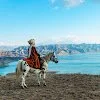
I was cast in the episode. We rode up to the pasture where the horses were grazing, and I sold Conor four of them. One was ‘Martin’ a spotted horse. Conor rode that one and he became a favorite and featured in the episode.
For Conor, the deal turned out to be hard going. Between local rules and costs that kept adding up, the profit he'd been counting on slipped further away at every step. He took the horses south to the market in Uzgen to sell them, and the crew moved on. Six months later, the series went out on TV around the world.

A breeder in New Zealand
A few years later, on the other side of the world, a New Zealand Appaloosa breeder named Scott Engstrom saw the episode. She noticed the spotted horse Conor was riding and thought it looked exactly like her own Appaloosas. She'd long believed the breed's roots were in Asia, not Europe, so she wrote to Conor to tell him. Then she kept writing.
Eventually Conor took her seriously and got in touch with me about testing the horses' DNA. By then I'd started noticing spotted horses all over Kyrgyzstan, and I'd even bought one at a livestock market just to study it. We spent two years preparing, and in 2012 we went out to film what became "True Appaloosa."
In the film, Dr E. Gus Cothran of Texas A&M University, who ran the tests, said: “About half the horses tested carried the Leopard complex gene responsible for the Appaloosa spotting pattern. Comparing that region across Kyrgyz, US and European horses suggests, though doesn’t prove, that the mutation may have first arisen in Asia.” Whether the Chaar is the Appaloosa's ancestor is still an open question. A one-hour version of the film aired on the BBC in January 2015, and the full film premiered at the Sun Valley Film Festival that March.
None of it was planned. One horse deal for a TV show put a spotted horse in front of the right person, and that's how the Chaar revival began. Today there are more than 70 Chaar horses at our ranch in the Ketmen-Tobo Valley.
You can watch "True Appaloosa" for free on our film page.
With all the best,
Munarbek